Anna Bartlett ▸ Co-op Experience ▸ Central Co-op

Central Co-op
Strengthening the co-op experience: brand, reach, and research, built over a six-month co-op.
THE STORY, BY SECTION
THE OFFICE
One question underneath the brand.
In 2024, Northeastern's Chancellor created Central Co-op inside the Education Innovation division to strengthen cooperative education across the university. When I joined for a six-month co-op, the office had three staff members and three co-op students. I was the only one with a design and marketing background, so I led the office's brand. Underneath it was one question: what would make employers want to hire more co-op students?
THE BRIEF I WAS ACTUALLY GIVEN
100 followers and a missing question.
I was handed an Instagram account, @nucoopeducation, with about 100 followers. The goal was for it to become a resource for every Northeastern student, showing them everything available to them.
~100
FOLLOWERS ON DAY ONE
1,000
REACHED RIGHT BEFORE THE CO-OP ENDED
900%
FOLLOWER GROWTH
OPEN THE FOLDER
While making the first posts, I was surprised by how much I hadn't known as a student myself. The career design office ran resume and networking workshops every week. Everything I had heard about co-op came from the College of Arts, Media and Design, and I only found other resources because friends in the business school told me about them. Each college was doing well at its own outreach. The information just stayed inside each college.
The brief assumed students needed to know the resources existed. What I noticed was that students were falling into the gaps between colleges, while also trying to keep excellent grades in a competitive major. As a student inside the system I was designing for, I could see those gaps firsthand.
Career design workshops, every week
ONE ACCOUNT SHOWS EVERY STUDENT
Research is where I go even when no one asks. Before I did a deep dive, I checked with my boss that it was worth exploring.
A PROFILE FOR EVERY MAJOR
One template, almost every major.
My first task, alongside the Instagram account, was a set of student profiles. Working with my co-op co-workers, I made one for almost every major and combined major at Northeastern. We called them personas, but they weren't a tool for our own design team. They were for the people doing employer outreach, to show a company exactly what kind of student it gets when it hires a Northeastern co-op.
To represent an average student fairly, I met with as many academic advisors across the colleges as I could, because they knew what their students actually study and can do. The advisors also reviewed and approved the profiles before they went to the Chancellor's office.
I built every profile from one InDesign template, centered on a student at a specific stage, like an animation student seeking a first co-op. Each covered personal attributes, relevant coursework, projects or past positions, industry-aligned skills down to the software, and the job titles or fields that student could grow into. The sections shifted slightly by major: an animation student is described by projects, a communications student by the positions they have held. A recruiter reading their fifth profile already knows where to look.
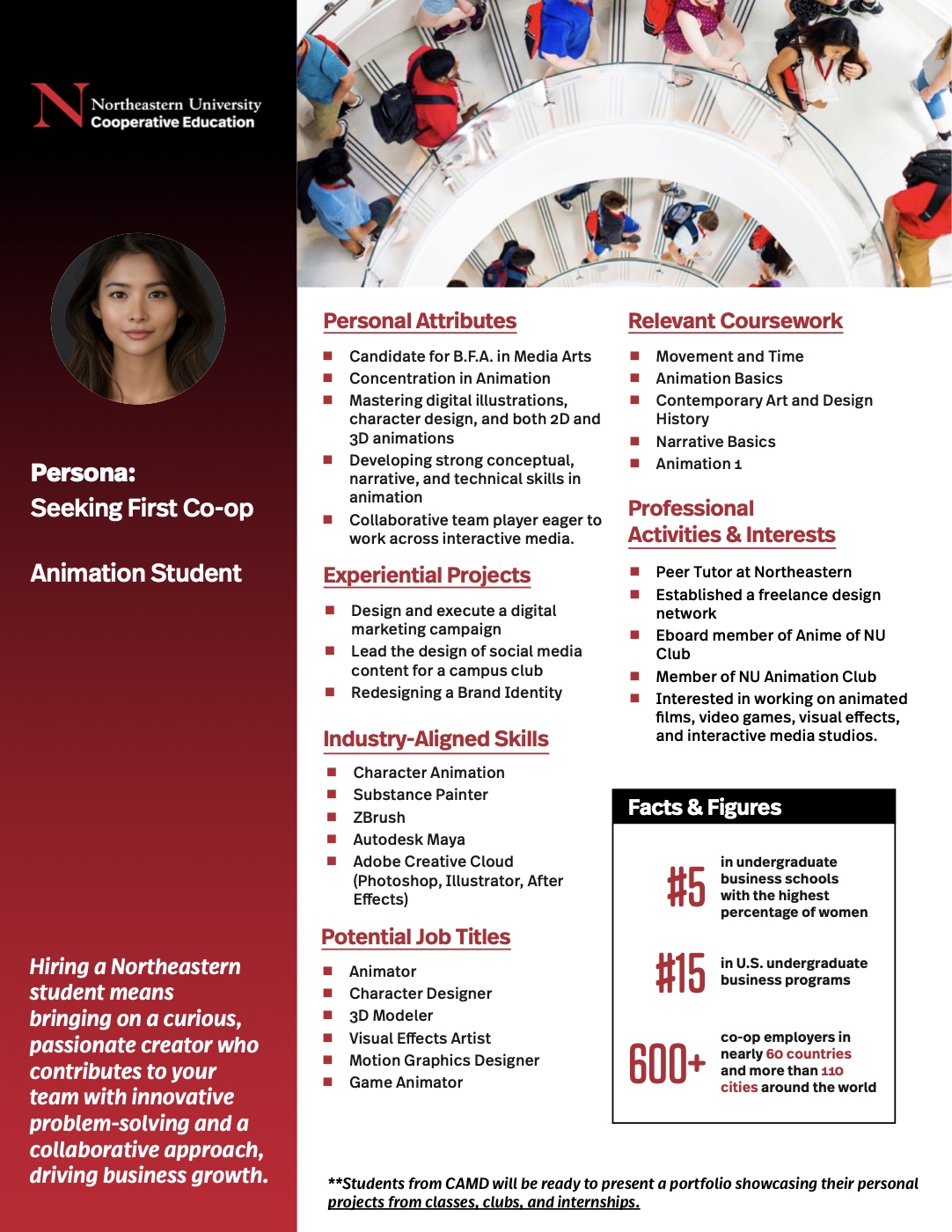
ANIMATION · SEEKING FIRST CO-OP
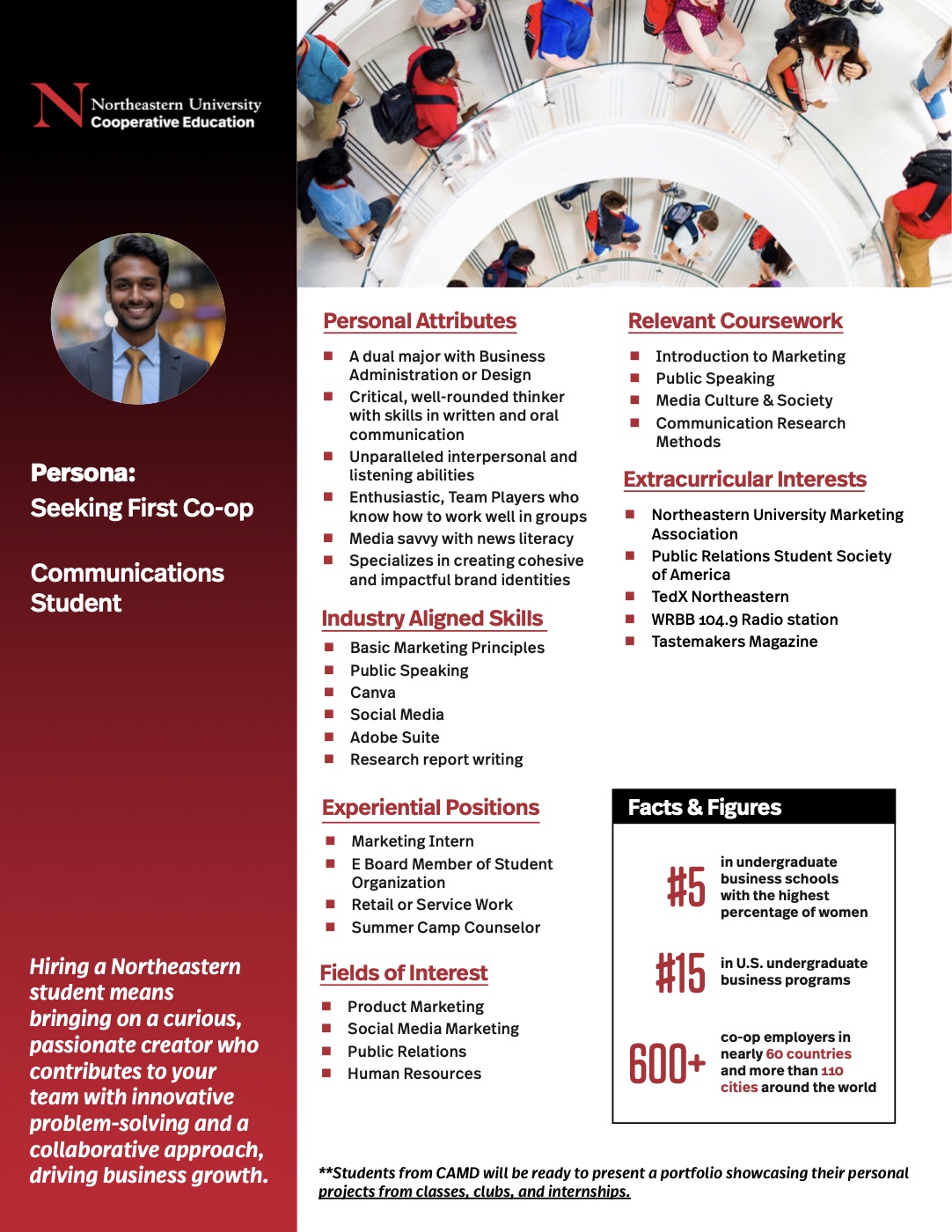
COMMUNICATIONS · SEEKING FIRST CO-OP
COMPARE ONE PART OF THE TEMPLATE
ANIMATION
Experiential Projects
- Design and execute a digital marketing campaign
- Lead the design of social media content for a campus club
- Redesigning a Brand Identity
COMMUNICATIONS
Experiential Positions
- Marketing Intern
- E-Board Member of Student Organization
- Retail or Service Work
- Summer Camp Counselor
ALL THIRTEEN PROFILES
Every profile described a student seeking a first co-op, and that was the strategy. The goal was more entry-level jobs on NUworks, because first-time seekers struggled most. Once a student had one co-op, the experience problem mostly went away.
The hardest profiles were the majors without a set path. An architecture or engineering major hands you specific skills. Marketing, communications, media, and the arts don't. A marketing student could position themselves toward design or toward SEO and engagement, and a combined major made it vaguer still. Some engineering and design students applied mainly to engineering jobs, not the design jobs I would have applied for.
If I made them again, I would drop the stock portraits and the business-school rankings, which don't belong on an arts and design profile.
THE METHOD
Two rounds of research, built from scratch.
The student profiles were my first round of research, built from conversations with academic advisors. The focus groups came later in the co-op, as a second round that went to students directly. By then, my co-workers and I had spent months noticing gaps from the student side, but noticing wasn't enough. To get those ideas heard, we needed evidence: many students saying it in their own words, not a few co-ops saying it for them.
I proposed a topic, and once my supervisor approved it, I wrote the protocol: questions phrased so they wouldn't push students toward an answer. We recruited with a mail merge to student lists from the co-op coordinators. The email made one promise a survey couldn't: a real conversation, with feedback going directly to the Chancellor's office. A sign-up form asked for home college, class year, number of co-ops, combined major, international status, and availability, and we assigned each student a session based on their answers.
STEP 01 OF 9
Pitched a focus group topic. My supervisor approved it before anything else happened.
ONE SESSION · 60 MINUTES, TO SCALE
SESSION 1
5 to 8
STUDENTS
SESSION 2
5 to 8
STUDENTS
SESSION 3
5 to 8
STUDENTS
SESSION 4
5 to 8
STUDENTS
Four sessions, twenty-five students, grouped by co-op experience.
Twenty-five students took part across four sessions of five to eight people at the Stearns Center, grouped by co-op experience so the conversation could flow. Each session paired 50 minutes of discussion with 10 minutes of live, anonymous Mentimeter polls. The discussion gave us the reasons, and the polls gave us numbers we could chart. The polls also let quieter students take part without speaking up, and in the discussion I invited them in by name. Justin and I were the same age as the participants and had been through the same search, so we had to be careful to keep our own opinions out of the room.
Every session had a notetaker and a recording. Once all four were done, we combined the notes with the poll data to draw conclusions. Before I left, I wrote the whole process up as a guide for the co-ops who came after me, including what we would change.
WHAT THE POLLS SHOWED
Asked out loud, answered on their phones.
The polls took ten minutes of every session, and they caught what students would type but not say out loud.
The first poll asked for one word to describe the co-op search. Twelve students sent 23 words. Stressful came up most, then long, and only one student wrote anything positive: straightforward. The rest fell into three groups. Some words described a feeling: anxious, nervous, isolating, draining. Some described the effort: long, tedious, arduous, busy, intense, difficult. A few described the system itself: chaotic, competitive, unresponsive. That last group is the one a university can actually change, and unresponsive is exactly what our suggested NUworks application dashboard was meant to fix.
- difficult
- arduous
- straightforward
- draining
- emerging
- nervous
- tedious
- anxious
- stressful
- crappy
- busy
- long
- isolating
- preserving
- intense
- unresponsive
- chaotic
- competitive
Twelve students, 23 words. Bigger means more students chose it.
Eleven students then ranked four obstacles. Competition came first, then interview preparation, then professional networking, with resumes last. Resume help already existed: the career design office ran workshops every week. Even so, one student's open answer asked for a resume workshop, the same visibility gap I had run into myself while making the first Instagram posts. Several other answers pointed at the real gap from another side: have projects before your first cycle, build projects for your resume, start gaining experience before co-op begins. The hard part wasn't writing a resume. It was having something to put on it, which is the Northeastern Paradox again. Interview preparation, ranked second, was the top obstacle the university could most directly teach, especially the technical interviews STEM and media arts students told us they felt unready for.
A ranking, so there are no bar lengths here to suggest distances nobody measured.
Some students had to leave before the end, which is why the later polls have fewer responses than the first. Asked which campus resource they used most for co-op guidance, 73% of the 11 students who answered named their co-op advisor. NUworks got 18%, the co-op class 9%, and Career Services none.
Co-op advisor: 8 of 11 students. One person carrying most of the guidance.
The number that stopped me was the 73%, with a zero beside Career Services. The resources existed, but students relied almost entirely on one person. Their advisor was helping with applications and also trying to be the mentor students wanted, someone to walk them through it. That's a lot for one person to carry, and it makes it hard to answer every student's email quickly. It also makes the advisor easy to blame when a student doesn't land a co-op. The advisor wasn't the problem. They were carrying work the rest of the system should have shared.
THE REAL PROBLEM
To get a co-op, you already need experience.
We called the underlying problem the Northeastern Paradox. Co-op is supposed to give students the work experience that helps them land a real job. To get a co-op in the first place, they already need work experience.
Every session ended on one open question: what's one piece of advice or resource that would have made your co-op search easier? Across fourteen answers, the word that showed up in both sessions was guidance: guidance for international students, guidance on creating your own co-op. Most of the other answers asked for the same thing in other words. They wanted portfolio advice and resume workshops, and they wished they had known sooner to build projects, take certain classes, and look beyond NUworks. They were asking to be shown the way earlier.
Two answers pointed to who could do the showing: a mentor who had done a co-op and could refer them, and a website where past Northeastern co-ops share what working at a company was like. Northeastern can feel individualistic because everyone is job hunting at once and trying to stand out. Mentorship from students who have done a co-op at the same company would turn that informal knowledge into intentional guidance. A younger student hears from someone who got there, which keeps them hopeful enough to trust the process. The older student gets a leadership role for their resume. Both help close the gap between class years.
Have projects before applying (first cycle) that you can talk about.
resume workshop
Start gaining professional/technical experience as soon as you can before Co-Op starts.
Had more sessions on building projects for resume and more intensive questions for different technical questions.
portfolio building advice
There's a website which has previous neu coops giving their experience at a company. Really helpful to watch before interview prep, and why they want to apply
Don't be afraid to turn down offers
Guidance for internationals! Less jobs and even less return offers generally
Job searching sucks if you're an art related major
I find myself split between academic responsibilities and application efforts.
Take clinical skills classes earlier to expand job options.
More guidance on creating your own co-op would have been good. It was relatively easy to set up for me but really worked because I was able to reach out to my connections and advocate for myself.
Find a mentor or people with different coops and just have them refer you to their coop - for your first one at least will make it a lot easier
Knowing about the pacing/course scheduling of the major as well as knowing what my options were outside of NuWorks. Once I learned how to self-develop a co-op I never looked back.
All fourteen answers, verbatim, from the two sessions that reached this question.
Northeastern encourages students to combine majors, and employers want people who can work across disciplines. That meant the brand couldn't belong to any one college. It had to represent all of them, which let our office become the "gray area": the place an employer could bring a job that fit more than one major.
Employers had the opposite problem from students: too many applications, not too few. Majors without a set path were where it got crowded. A marketing or communications co-op drew applicants from every college, including engineering and computer science students desperate for any job. Students were applying just to apply, and recruiters were overwhelmed by applicants who hadn't read the qualifications. My supervisor set a cap of 100 applications per co-op cycle. It worked less like a limit and more like a signal. Reaching it told the student's co-op advisor that this student might be struggling and needed a check-in, so an advisor stretched across many students could see who to help first. After a conversation about what kind of role the student actually wanted, or once they withdrew some applications, the advisor could lift the cap. Students in our focus groups still named the cap as a pain point.
- 01Applying
- 02Reaches 100
- 03Advisor checks in
- 04Cap lifted
Drag to 100 to see what the cap does.
A signal, not a wall. Students in the focus groups still named it as a pain point.
WHAT I'D DO DIFFERENTLY
What the first run taught us.
Some of it didn't work. We asked students how it felt to be rejected from a co-op, and the answers were honest but gave the administration nothing to act on. Every question should lead to something someone can change. Our notes were thorough, but they didn't record who said what. Without each student's major and class year beside their words, we couldn't see whether a problem belonged to one college or all of them, which was the question that mattered most.
The groups themselves were uneven. Some colleges were far better represented than others, attendance changed from session to session, and our team rotated between moderator, scribe, and observer. Students who signed up didn't always show up, so next time I would invite more students than each session needs and send a confirmation the day before. We also sent invitations too late in the semester. A student later suggested reaching student clubs through Instagram, which would have been a better way to recruit.
- QUESTIONSAsked how rejection felt. Honest answers, nothing to act on.
- NOTESThorough notes, but no record of who said what.
- TURNOUTStudents signed up and didn't always show up.
- TIMINGInvitations went out late in the semester.
- REACHRecruited through a mail merge alone.
THE ROOM
The suggestions may not last. The method did.
We presented the research to the Senior Vice Chancellor for Education Innovation and members of her team. The research team was Justin Williams, Daniel Zhou, and me.
We opened by being fair about the problem: job searching is stressful everywhere, not only at Northeastern. The question was whether the university was doing everything it could to ease that stress. Then we walked through the method, the three areas students struggled with (the application process, emotional and mental wellness, and professional development), and the poll data.
We ended with four suggestions. First, a real-time application dashboard in NUworks, so students could see where they stood, and employers would be held accountable. Second, career preparation organized by industry instead of by major, since careers now cross disciplines. Third, a bigger role for the Career Design Center, to take pressure off co-op advisors. Fourth, a first-year Intro to College class rebuilt into an actionable guide to becoming marketable before the search starts. We named the study's limits and closed on the Northeastern Paradox.
THE EVIDENCE BEHIND SUGGESTION 01
- "Unresponsive" in the one-word poll
- NUworks transparency named as a pain point
- "Stressful" and "anxious" in the one-word poll
Leadership's main question was the sample. Twenty-five students is small for a university the size of Northeastern. The honest answer was attendance. Students signed up for times they said they were free, then didn't show up or stopped responding once we assigned them a session, and some who came had to leave before finishing the polls. Those were first-run problems, mostly outside our control.
What lasted was the method. Nothing like it existed before, and we built it from the ground up as co-ops. It had its quirks, but the framework is what the office kept: it goes into the Central Co-op archives for the co-ops who come after us, as the office grows.
I don't know whether any of the four suggestions were acted on. The presentation was well received, and our whole team was proud of it, especially since we built it alongside everything else we were doing as co-ops.
WHAT I TOOK WITH ME
My first real client.
This was my first professional design role, with a real office, real stakeholders, and work that shipped: a brand deployed at career fairs, a social presence grown 900%, and research that put student voices in front of the people who run co-op. Institutional design is three jobs at once. You build the identity, you earn the audience, and you bring the evidence.
JOB 02
Earn the audience
The research also showed where to look next: how students experience the one-credit co-op course, what it does well, and what it could do better.
The most useful thing a designer can do inside an institution is make what students actually experience impossible to ignore.