Anna Bartlett ▸ Central Co-op ▸ User research
User research
Twenty-five students, and the thirteen sheets it produced.
The evidence behind the work.
We built a large sampling frame, grouped interested students by availability, and ran focus groups — 50 minutes of structured discussion plus 10 minutes of live Mentimeter polls. Twenty-five students surfaced three areas of challenge in the Northeastern co-op process: competitive nature, emotional and mental wellness, and professional development.
TEN MINUTES OF EVERY SIXTY · THE LIVE POLLS
Asked out loud, answered on their phones.
Fifty minutes of discussion, then ten of Mentimeter. The polls were there to catch what a room will type but not say — and they are the part of the research that reads the same to a stakeholder as it did to us.
- isolating
- anxious
- stressful
- long
- emerging
- preserving
Six words from seven students, set at one size because that is what the data says — each was one person answering once. Five of the six describe a feeling rather than a task.
Two points of gap, and it falls on the half the university teaches most explicitly. Students rate themselves better at talking to a stranger than at the résumés, portfolios and technical screens the co-op class is supposed to cover.
100%
said their co-op advisor. Career Services, the co-op class, NUworks and “other” each took nought.
A clean sweep is not a chart, so it is not drawn as one. It is also the most load-bearing number in the study: every student was routed through one person, and the offices built to share that load were not being reached.
- 01Competition level
- 02Professional networking
- 03Interview preparation
- 04Resume development
Ranked, not scored — so there are no bar lengths here to imply distances nobody measured. What the order says is that the two things students put at the top are the two the university has least control over.
Take clinical skills classes earlier to expand job options.
Find a mentor or people with different coops and just have them refer you to their coop — for your first one at least will make it a lot easier.
More guidance on creating your own co-op would have been good. It was relatively easy to set up for me but really worked because I was able to reach out to my connections and advocate for myself.
Knowing about the pacing/course scheduling of the major as well as knowing what my options were outside of NUworks. Once I learned how to self-develop a co-op I never looked back.
Three of the four answers describe something a person told them, not something the university published. That is the finding the office could act on: the co-op process was already being taught peer to peer, just not by design.
WHAT THE RESEARCH WAS FOR · THIRTEEN SHEETS
Translating a major into an employer’s language.
The focus groups told us what students were carrying. These told employers what students were bringing. Every arts, media and design major got a sheet — the coursework they have actually taken, the skills that map to an industry title, and the roles they could be hired into. One template, thirteen majors, so a recruiter reading their fourth one already knows where to look.
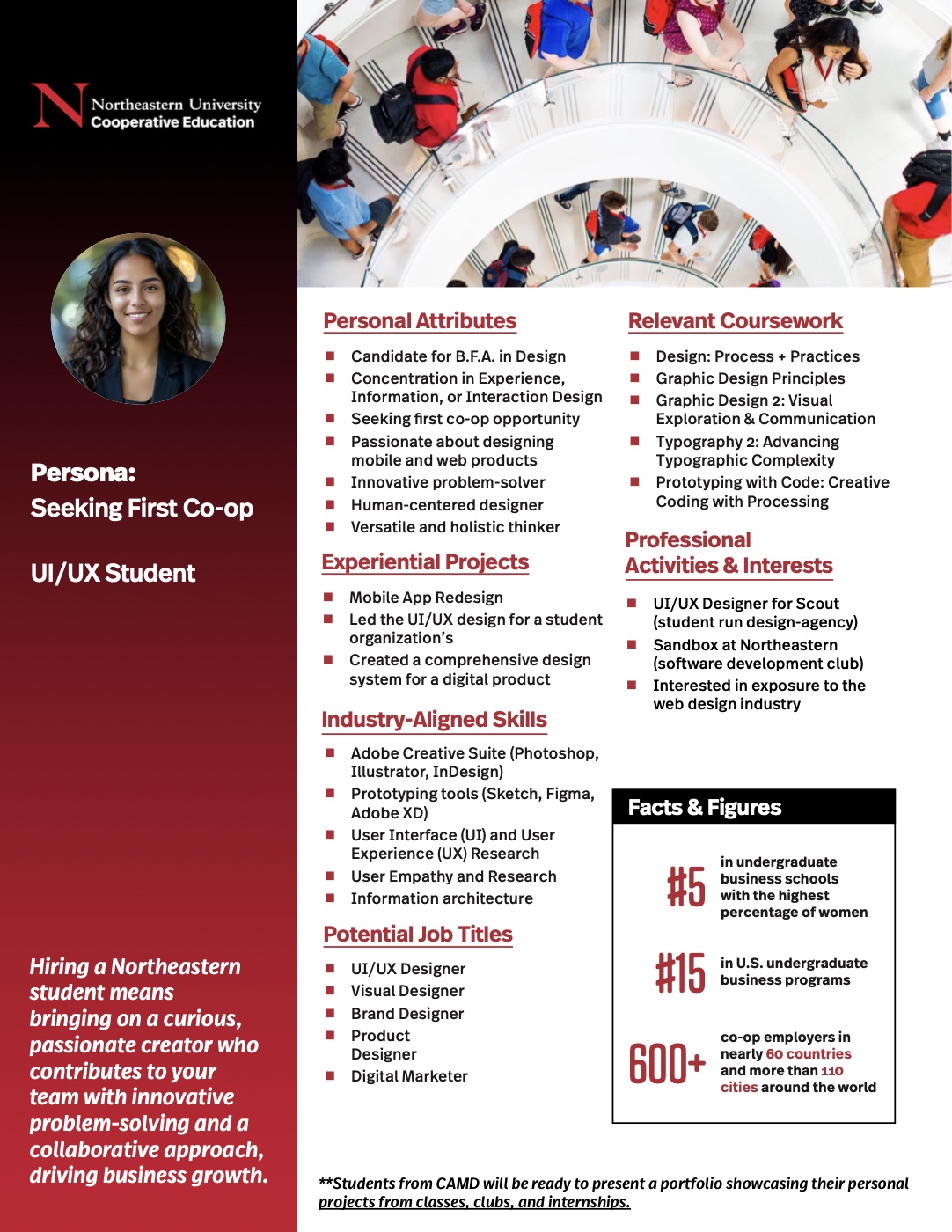
01 / 13 · UI / UX
The sidebar carries a different colour per major and the rest of the grid holds still, which is the whole trick: a set of thirteen has to read as one set. It is also the piece of this co-op I would redo first — the sheets use stock portraits and lean on business-school rankings that do not belong on an arts and design page.